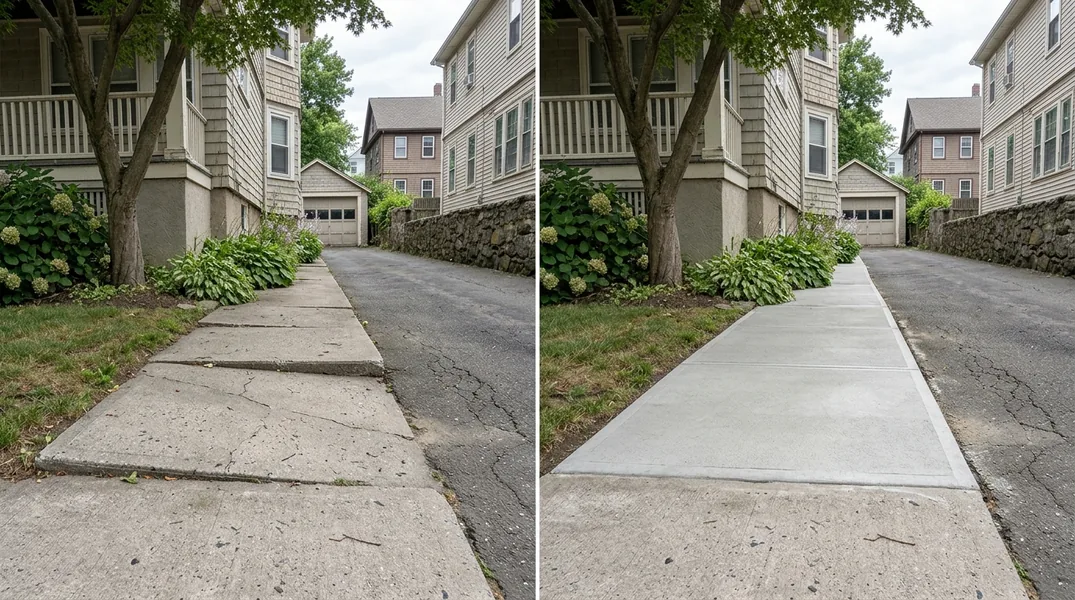
Understanding New Haven's Harsh Concrete Environment
New Haven sits in a region where winter and spring team up to wage war on concrete. Unlike warmer climates where concrete simply ages gracefully, our New England location subjects driveways to a relentless cycle of freeze-thaw stress that accelerates deterioration far beyond normal wear. This isn't just about snow and ice; it's about the specific geological and meteorological conditions that make New Haven particularly challenging for concrete longevity.
The problem starts with moisture. Concrete is porous, and when water seeps into those tiny pores during autumn rains or spring melts, it settles in for the winter. When temperatures drop below freezing, that water expands with tremendous force. Ice takes up roughly 9% more volume than liquid water, and this expansion happens inside your concrete's matrix. Repeat this cycle dozens of times each winter, and you're essentially applying pressure from within that no concrete can indefinitely withstand. By the time spring arrives, hairline cracks have formed, and the damage has begun.
Freeze-Thaw Concrete Damage: How It Destroys Your Driveway
Freeze-thaw concrete damage in New Haven follows a predictable pattern that homeowners should recognize early. The first winter might show only minor surface scaling, where small flakes of concrete begin to peel away. This seems cosmetic, but it's actually the beginning of structural failure. Each subsequent winter deepens the damage as more water finds its way into newly created cracks and repeats the expansion cycle. Within three to five years, a driveway that looked solid can develop significant spalling, where chunks of concrete break away, leaving rough, uneven surfaces that are both ugly and dangerous.
What makes freeze-thaw damage particularly insidious is that it's self-accelerating. Once cracks form, they act as highways for water penetration. The concrete around those cracks becomes weaker, more prone to cracking, and the cycle intensifies. A driveway that might last 20 years in Arizona can fail in half that time here in Connecticut. Homeowners often don't realize how serious the problem is until they step outside in spring and find their driveway looking like it's been through a war. At that point, Concrete Repair & Resurfacing becomes necessary, and the longer you wait, the more extensive and expensive those repairs become.
Road Salt and Concrete Scaling: A Winter Maintenance Problem
Road salt, while essential for winter safety, is one of the most corrosive substances your concrete will encounter. When municipalities and homeowners apply salt to driveways and roads, the salt dissolves in water and penetrates the concrete surface. This creates a chemical reaction that weakens the concrete's binding matrix and accelerates the freeze-thaw cycle. Concrete scaling from road salt is particularly visible in spring, when you see white, powdery residue on your driveway's surface alongside flaking and pitting.
The chemistry is straightforward but devastating. Sodium chloride (table salt) lowers the freezing point of water, which is why it works for de-icing. However, when that salty water seeps into concrete pores and refreezes, the salt concentration actually increases the expansion pressure compared to pure water. Additionally, salt can cause efflorescence, that white chalky coating you see on many driveways, which indicates that salts are migrating through the concrete and depositing on the surface. Over time, repeated salt exposure weakens the top layer of your concrete so severely that it can no longer hold together, leading to widespread scaling and deterioration.
In New Haven and surrounding areas, road salt application is heaviest from December through March, meaning your driveway faces months of continuous chemical assault. Even if you don't apply salt yourself, road salt spray from passing vehicles and municipal road treatments affects properties near major streets. This is why homeowners in our region should consider salt-resistant concrete mixes and protective sealants when installing new driveways, and why existing driveways need regular maintenance and inspection.
Glacial Till Soil: The Underground Foundation Problem
Beneath much of New Haven lies glacial till, a dense mixture of clay, silt, sand, and rocks left behind by glaciers thousands of years ago. While this soil provides excellent structural support in many ways, it creates unique challenges for concrete driveways. Glacial till is highly compressible and retains moisture exceptionally well, meaning water doesn't drain away from your concrete foundation as quickly as it would in sandier or rockier soils. This extended moisture contact period increases the likelihood that water will penetrate your concrete before it has a chance to evaporate.
The poor drainage characteristics of glacial till mean that even a well-installed driveway sits on a foundation prone to holding water. During spring thaw and heavy rains, this water accumulates beneath and around your concrete, creating ideal conditions for frost heave and settlement problems. Frost heave occurs when water in the soil below your driveway freezes and expands, causing the concrete above to shift, crack, and become uneven. This is why driveways in glacial till areas often develop center cracks or show signs of differential settling, where one section of the driveway rises higher than an adjacent section.
Understanding your soil composition is crucial when planning new Concrete Driveways or evaluating damage to existing ones. Proper site preparation, including grading for drainage and using the right base materials, can mitigate some glacial till problems, but the underlying geological reality remains. This is why professional installation matters so much in our region. Contractors experienced with New Haven's specific soil conditions know how to design and install concrete that can withstand these subsurface challenges better than generic approaches.
Signs Your Driveway Is Suffering from Freeze-Thaw and Salt Damage
Early detection of freeze-thaw and salt damage can save you thousands in repair costs. The first warning signs typically appear in spring, when you should inspect your driveway carefully. Look for white, powdery residue on the surface, which indicates salt penetration and efflorescence. Check for hairline cracks, especially in the center of the driveway or along the edges where water tends to collect. Surface scaling, where small flakes of concrete have peeled away, is another red flag. These early-stage issues might seem minor, but they're your driveway's way of signaling that structural damage is underway.
As damage progresses, you'll notice larger cracks that branch out like spiderwebs, chunks of concrete missing (spalling), and increasingly uneven surfaces where sections have heaved or settled. If you see water pooling on your driveway after rain or snow melt, that's a sign that frost heave or settling has disrupted proper drainage. Potholes or crumbling edges indicate that the damage has reached an advanced stage. At this point, patching alone won't solve the problem; you'll likely need comprehensive Concrete Repair & Resurfacing or even full replacement.
Don't wait until damage is severe to take action. If you're noticing any of these signs, contact a professional concrete contractor in New Haven who can assess the damage and recommend the best course of action. The difference between addressing a problem early and letting it develop is often the difference between a $2,000 repair and a $10,000 replacement.
Protecting Your Concrete: Prevention and Professional Solutions
The best defense against freeze-thaw and salt damage is a multi-layered approach that combines proper installation, maintenance, and professional care. When installing new Concrete Driveways, specify air-entrained concrete, which contains tiny air bubbles that provide space for water to expand without cracking the concrete matrix. This is a standard best practice in cold climates and should always be part of your specifications. Additionally, ensure your contractor installs proper grading and drainage so water doesn't pool on or under your driveway. A 1 to 2 percent slope away from your home is ideal.
Sealing your concrete every two to three years is one of the most cost-effective preventive measures available. A quality concrete sealer fills surface pores and creates a barrier that slows water penetration. This doesn't make your concrete waterproof, but it significantly reduces the rate at which moisture enters the concrete, giving it more time to dry between wet periods. In New Haven's climate, this small reduction in moisture absorption can translate to years of additional driveway life.
Minimize salt use on your property by using alternatives like sand, kitty litter, or calcium chloride products that are less damaging than sodium chloride. If you must use salt, apply it sparingly and rinse your driveway in early spring to remove residual salt. Avoid deicing products that contain ammonium nitrate or ammonium sulfate, which are particularly aggressive toward concrete. These simple habits, combined with regular inspection and prompt attention to emerging damage, can dramatically extend your driveway's lifespan. If damage does occur, professional Concrete Repair & Resurfacing can address the problem before it becomes catastrophic. Contact New Haven Concrete at (475) 234-3917 or request a free estimate to discuss your driveway's condition and the best protection strategy for your home.
Looking for a professional concrete contractor in New Haven? New Haven Concrete responds fast for all your concrete needs.
Get a Free QuoteOur services: Concrete Driveways · Concrete Patios · Stamped & Decorative Concrete